Table of Contents
ToggleA cluttered desk doesn’t just look bad, it tanks productivity. Whether you’re answering emails, juggling spreadsheets, or building a side hustle, the right home office desk with storage keeps supplies within arm’s reach and keeps your mind clear. In 2026, desks have evolved beyond simple surfaces: they’re now integrated storage powerhouses that fit real homes with real space constraints. This guide walks you through the styles, features, and strategies to find a desk that works for your workflow and your square footage.
Key Takeaways
- A home office desk with storage reduces visual clutter and mental fatigue, allowing you to focus longer and find supplies without disrupting your workflow.
- L-shaped desks with built-in shelving provide multiple work zones and maximum storage capacity for complex tasks, while compact desks with drawers and cubbies offer nimble solutions for small spaces.
- Height-adjustable desks and proper cable management are essential features that improve comfort, health, and productivity in a home office setup.
- Vertical storage solutions, wall-mounted desks, and floating shelves maximize limited floor space without sacrificing functionality or aesthetic appeal.
- Strategic curation of displayed items and coordinated storage containers create a professional, intentional look that prevents workspace clutter from overwhelming small home offices.
Why Desk Storage Matters for a Productive Home Office
A desk without storage forces you to choose: keep essentials in arm’s reach and sacrifice surface space, or lock everything away and waste time hunting for scissors and sticky notes. Studies on workspace design consistently show that visual clutter drains mental energy, even when you’re not consciously aware of it. More importantly, good storage means you’re not stacking papers, charging cables, and writing supplies into towering piles that eventually topple onto your keyboard.
Desks with built-in or integrated storage solve this directly. File drawers keep documents organized. Shelves and cubbies hold reference books, binders, and decorative items. A few open shelves let you display what you actually use (monitor risers, pen holders, speakers) while closed storage keeps the rest out of sight. The result? You look focused during video calls, find what you need without derailing your workflow, and leave the desk feeling calm instead of buried. For most home workers, this shift alone improves how long you can concentrate before needing a break.
Desk Styles and Storage Configurations to Consider
Not all desks are created equal. Your workspace size, work style, and budget determine which configuration makes sense. The market has matured enough that you can find quality options across price points, you just need to know what’s out there.
A desk’s footprint is its first constraint. Compact L-shaped setups fit corner spaces and give you two work surfaces (one for screens, one for papers or handwork). Straight desks take less floor space but concentrate your work onto a single surface. Floating or wall-mounted desks save the most square footage in tiny rooms, though they sacrifice storage capacity and may require wall anchoring into studs. The underlying rule: measure your space first, sketch the layout, then hunt for desks that actually fit.
L-Shaped Desks With Built-In Shelving
L-shaped desks are the workhorses of home offices. One arm handles your monitor setup: the other becomes your work surface or storage platform. When paired with shelving units or storage hutches (the overhead structure attached to or integrated into the desk), they transform into full command centers. The shelves keep reference materials, files, and decorative pieces visible but organized. You can also anchor monitor risers, which creates a shelf underneath for supplies.
The trade-off? L-shaped desks demand a corner. They typically need at least 48–60 inches of wall space in each direction. If your room doesn’t have a suitable corner, or if your workflow demands you face the room rather than nestle into a corner, this style might feel cramped. But for writers, designers, accountants, anyone who needs multiple zones, the layout pays dividends.
Compact Desks With Drawers and Cubbies
Small apartments and spare bedrooms often call for compact desks. These run 36–48 inches wide and rely on vertical storage: drawers underneath, cubbies or open shelves built into the frame, and sometimes a narrow hutch or shelving unit mounted above. Compact desks don’t offer as much work surface as L-shaped versions, but they’re nimble. They fit into tight corners, against windows, or even into closet nooks.
Drawers are your hidden weapon. A single file drawer holds a year’s worth of documents. Smaller drawers keep office supplies (pens, clips, Post-its) from scattering across the surface. Cubbies, the small open compartments, let you stash USB drives, notepads, or headphones where you can grab them in seconds. Some models use a ladder shelf design, stacking boxes or cubbies at angles, which looks visually lighter than a solid cabinet. This modern home office desk approach proves that small desks don’t mean small storage.
Key Features to Prioritize When Selecting Your Desk
Beyond style, focus on features that directly impact how you work.
Height adjustability matters more than many people realize. Standard desk height is 29–30 inches, which works for most people of average height when seated. But if you’re very tall or very short, or if you alternate between sitting and standing, an adjustable (often electric) desk pays for itself in comfort and health. Sit-stand desks let your legs rest during long calls and let you shift position every hour, which reduces back strain. Quality adjustable desks now cost $200–400 for budget models and $400–800+ for premium versions with multiple memory presets. If budget is tight, get the height right first: you can always add a standing pad or a desk extender later.
Material quality directly affects longevity. Solid wood (oak, walnut, maple) is durable and timeless but pricey and heavy. Engineered wood (plywood, MDF, or particle board with veneer) is lighter and cheaper but won’t last through a move or two. The real metric: check the weight rating for the desk surface and storage units. A desktop that sags under monitor weight is maddening. For storage, five-sided construction (solid back, sides, bottom, and top) beats open-back cubbies that wobble.
Don’t overlook cable management. Desks with built-in cable trays, grommets, or passages keep cords from tangling into a nest behind your desk. This is especially important if your storage includes shelves where you’ll rest a router, speaker, or charging dock.
Stability is non-negotiable, especially for compact desks. A wobbling surface breaks concentration and feels cheap. Shake the legs and frame before buying. For modular home office furniture, confirm that units lock together securely, you shouldn’t be able to shift them by leaning on the surface.
Space-Saving Solutions for Small Home Offices
Tiny home offices call for ruthless prioritization. You have room for a desk and maybe a chair, so every inch must earn its keep.
Wall-mounted desks are the ultimate small-space solution. They fold down when not in use, pivot to other angles, or attach permanently to a stud (critical, don’t mount to drywall alone). A fold-down desk might measure just 36 inches wide and 20 inches deep but frees up your floor when you’re done working. The downside: you’re limited on built-in storage, so you’ll need to pair it with floating shelves above or a tall, narrow bookcase or shelving unit beside it.
Vertical storage becomes your best friend. Instead of a desk with drawers underneath, consider a setup where the desk is just a surface, and a tall cabinet or shelving unit (24–30 inches wide, floor to ceiling) sits beside or behind it. This uses wall space instead of floor space. Home office built-in office cabinets maximize every inch, though they usually require professional installation if you want them integrated into the wall itself.
Open shelving looks cleaner and feels less cramped than closed cabinetry. If you can keep your workspace minimal (just essential items on display), home office bookshelves or a simple ladder shelf provide storage without the visual weight of cabinet doors. Pair this approach with hidden storage, a thin drawer under the desk, a cabinet behind a door, so you can tuck away the stuff you don’t want to see every day.
The key principle: measure first, sketch it out, and commit to a layout where the desk and storage complement each other rather than competing for space.
Maximizing Storage Without Sacrificing Style
Here’s the truth: a desk crammed with clutter looks chaotic no matter how expensive the piece. Smart storage layout makes everything look intentional.
Curate what you display. Open shelves and cubbies should hold items you either use daily or love looking at, a plant, a few meaningful books, a framed photo, your favorite mug. Everything else goes into drawers or closed storage. This discipline prevents the visual noise that makes small offices feel cramped. Designate a “drawer of doom” for miscellaneous supplies: just keep it organized with dividers.
Use storage containers that match your desk’s material or color palette. Matching baskets in a cubby system, wooden boxes on shelves, or a set of matching file folders all create cohesion. Even inexpensive containers (woven baskets from home goods stores, cardboard file boxes with fabric covering) elevate the look when they’re coordinated.
Establish zones. Designate one area of the desk for active work (laptop, notepad, current project). Assign another area or shelf for reference materials. Keep supplies in one drawer. This mental organization prevents drift, where your desk slowly fills with random items because you’re not sure where things “go.” According to design pros featured on interior design resource sites, zones are especially powerful in small rooms where your desk is also a bookshelf and your office is also a guest room.
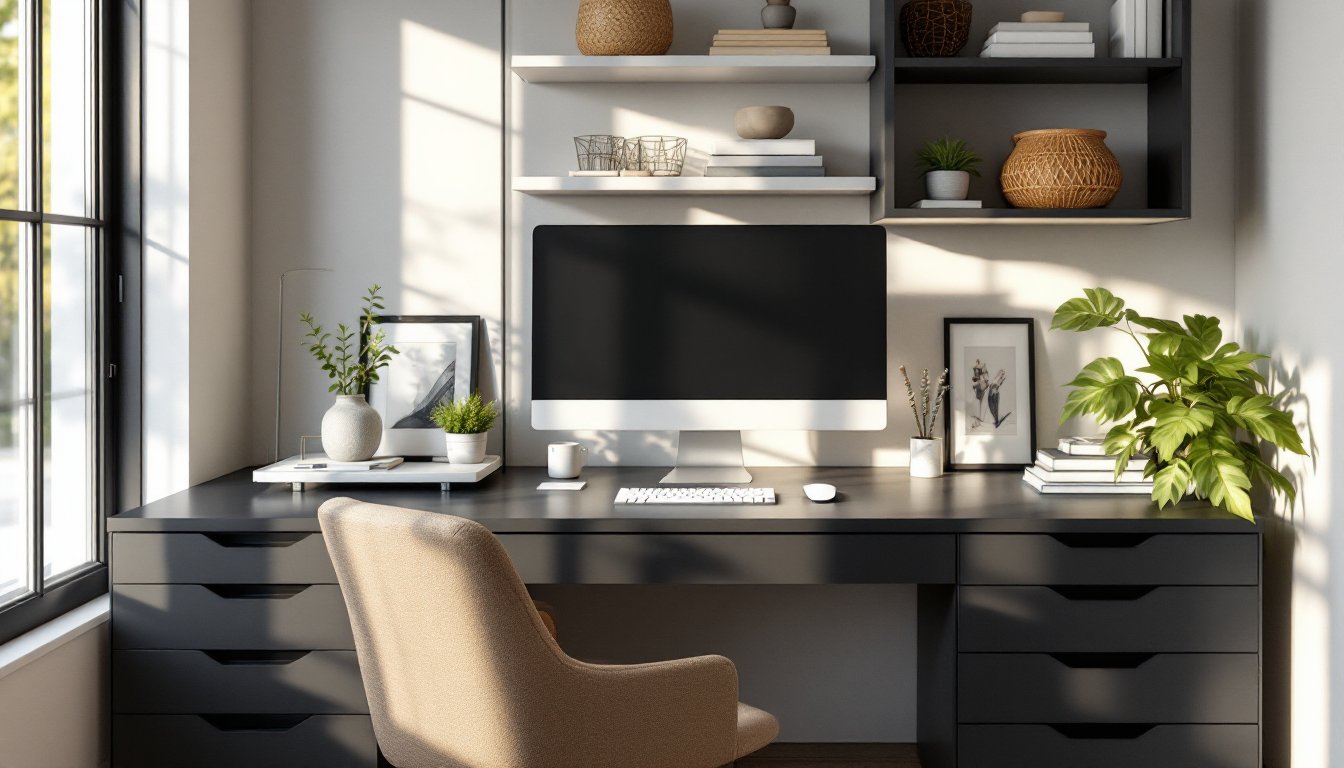
Finish counts. A desk in matte black, white, or natural wood looks purposeful. Avoid too-bright colors or mixed finishes (chrome and brass and glass all together) unless that’s your deliberate aesthetic. The goal is restraint: let the storage do the work, not the décor. A modern black home office design, for example, makes even a small desk with multiple drawers feel sleek because the dark finish visually grounds it.
The outcome: a workspace that looks organized and professional, whether you’re on a video call or just working solo. That peace of mind is worth more than the desk itself.